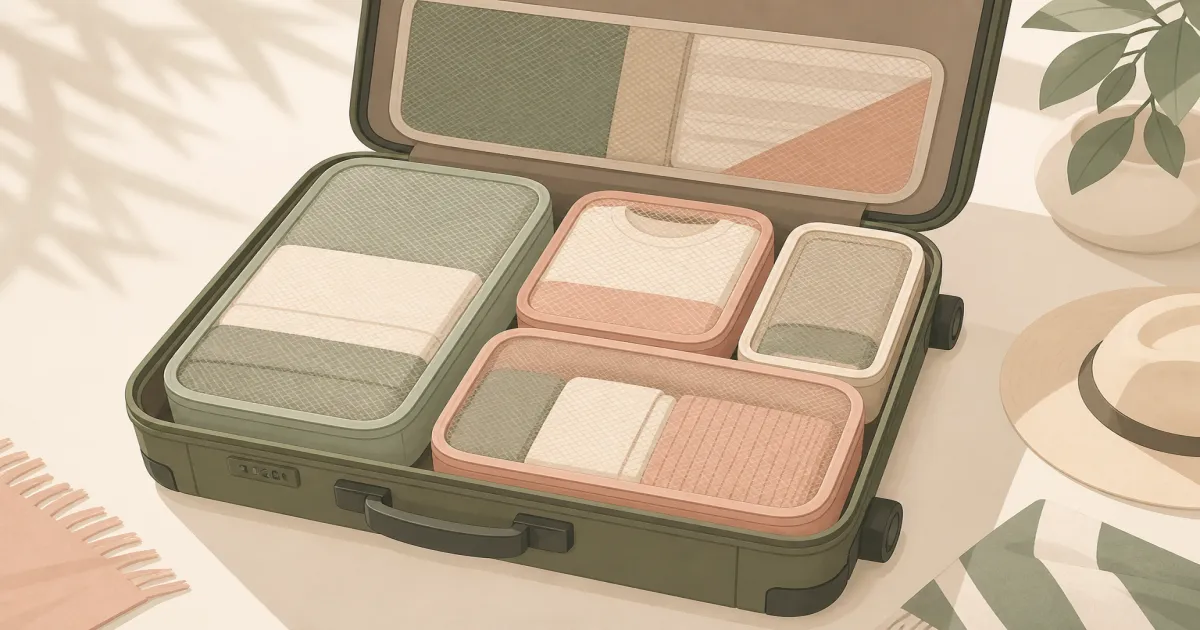
Best Travel Packing Cubes (2026): Sets That Organize a Suitcase
Packing cubes
The best travel packing cubes are a small sized set you refill the same way every trip. Start with mesh organization, then add compression only where jackets create bulk.
Our picks
The best travel packing cubes for US trips are a small set with listed sizes, zippers that clear fabric, and a layout you will refill without thinking. The Veken 8 Set is the one we hand most travelers: mesh lids so you can see the contents, four sizes, and a laundry bag, for about $2 a cube. Cubes organize a bag. They do not erase an oversized wardrobe, and tall cubes still dome a carry-on lid.
Start in the packing cubes category, then use the narrower guides under this pillar: best packing cubes for carry-on, best compression packing cubes, best cheap packing cubes, best packing cubes for women, and how to use packing cubes.
What do packing cubes actually do?
Cubes create zones. You can pull shirts without excavating pants. You can move a cube from suitcase to hotel drawer. You can isolate dirty laundry. That is the real job, and it is worth about what a set costs.
Do packing cubes save space or just organize?
Regular cubes mainly organize, they do not shrink clothes. Compression cubes remove air from soft layers and make a jacket stack thinner, but the clothes still weigh the same. So decide which problem you have: finding things, or fitting a bulky layer.
They do not magically erase volume either. If you pack seven jackets, cubes will still be full of jackets. Edit first, then contain.
What do you actually get in a set?
The trap in Amazon cube sets is piece count. A twelve-piece set sounds generous until you realize half the pieces are the same small size. What matters is how many useful zones you end up with.
How many packing cubes do you need for a week?
Three clothing cubes plus one laundry bag cover a week of casual clothes for one person. A fourth slim cube is worth adding for charging cables and a tablet. Anything past five pieces usually means you bought a set with duplicate sizes you will not refill.
That four-piece logic beats a twelve-piece rainbow set you will never refill the same way twice. Color coding helps if you share a bag with a partner. It is optional if you travel solo and label by size.
Which packing cubes should you buy?
Here is how the three picks compare on the things that decide a purchase: today's price, piece count, whether they compress, and who each one suits.
At $16.99, the Veken works out to about $2.12 a piece. The BAGAIL six-piece is about $3.48 a piece, and the Gonex four-piece is about $4.04 a piece. You are paying the difference for compression zippers and, on the BAGAIL, for 70-denier ripstop nylon.
Best overall: Veken 8 Set Packing Cubes
The Veken 8 Set Packing Cubes is the best travel packing cubes pick for most people. Four sizes cover pants, shirts, socks, and underwear, and the set includes a laundry bag, so you do not buy the dirty-clothes piece separately. It is sized for 20 to 34 inch suitcases, which covers everything from a personal item to a checked case.
More than 34,000 ratings sit at 4.6 stars, and the mesh panels are the reason it stays easy to use after the novelty wears off. You can see what is inside without opening each cube, and at about $2 a piece you can buy a second set for a partner or a kid without wincing.
Who it is for: Most travelers who want visible zones, a sized mix, and a laundry plan in one purchase.
Skip if: Your problem is bulky jackets in a carry-on and you want the second zipper that removes air. That is the BAGAIL job.
How much does the Veken 8 Set hold, and who is it for?
Four sizes plus a laundry bag hold roughly a week of casual clothes for one person: pants in the large cube, shirts in the medium, socks and underwear in the small, and a slim cube for cables. It fits carry-on personal items up to a large checked case.
Best compression: BAGAIL 6-Set Ultralight Compression Packing Cubes
The BAGAIL 6-Set Ultralight Compression Packing Cubes are the right choice when overhead-bin volume is the real problem. The middle zipper closes after the main zip, so soft layers give up air and the stack gets thinner. The fabric is 70-denier ripstop nylon, chosen to save weight, and the set is listed at about 1.5 lb for six pieces.
BAGAIL advertises up to 50% space saved through compression. Treat that as the best case on a full load of soft clothing, not a guarantee. Hard items and structured shirts do not compress, and compressing them anyway costs you the folds.
Who it is for: Cold-weather trips, knits and hoodies, and one-bag travelers counting weight.
Skip if: Your clothes are mostly cotton shirts that need to stay smooth. Regular cubes and a folder are gentler.
Does the BAGAIL compression zipper actually help?
Yes, on soft layers. A hoodie or fleece stack loses enough air to close a carry-on that otherwise bulged. On denim, dress shirts, and anything with structure, expect the zip to do little more than hold the shape.
Best starter: Gonex Compression Packing Cubes (4-piece)
The Gonex Compression Packing Cubes (4-piece) are the lean entry point. The set lists four sizes, from an XL at 17.3 by 13 by 3.5 inches down to a medium at 11.8 by 8.9 by 3.5 inches, and each has the second compression zipper. That is about 12.9 liters in the XL, 8.8 liters in the large, and 6.0 liters in the medium, roughly 27.7 liters across those three pieces.
At $16.14 for four cubes, you are paying about $4 a piece to test compression without committing to a six- or eight-piece set. If compression turns out not to matter to you, you have lost very little.
Who it is for: First-time cube buyers and travelers who want the compression idea without a big set.
Skip if: You want one purchase that covers clean, dirty, shoes, and socks. The Veken 8 Set covers more zones for similar money.
Is the Gonex 4-piece set enough for a week?
For warm-weather clothes and a carry-on, yes: three clothing cubes plus the fourth for socks or cables covers a week. For a cold trip with layers, you will want the bigger BAGAIL set or a laundry bag you already own.
Regular vs compression cubes: which should you buy?
Regular cubes organize; compression cubes also reduce bulk on soft items. Use compression on sweaters, hoodies, and bulky casual layers. Go easy on dress shirts and anything structured.
When is compression the wrong choice?
When it costs you a fold. A compressed dress shirt comes out creased, and a compressed blazer is a mistake. Keep compression for the soft, forgiving layers and leave the tailored pieces to a board-style packing folder.
If your whole problem is overhead-bin volume, read best compression packing cubes after you understand this pillar. If your problem is finding socks at 6 a.m., regular cubes are enough.
Carry-on vs checked vs backpack: which sizes change?
The cube job changes with the bag. A carry-on rewards slim cubes and fewer pieces. A checked case can take larger cubes and a bigger laundry plan. A backpack rewards soft cubes that do not fight its shape.
What changes for a checked bag?
You can use larger cubes, but still leave grab items in a personal item. Cubes that fill a checked bag wall to wall make a security search painful, so keep one zone loose. Larger-form sets suit this better; our checked luggage cube guide sizes it out.
For carry-on, see best packing cubes for carry-on. For backpacks, softer cubes and vertical loading follow the pack; details in packing cubes for backpacking.
How do you pack cubes so the system holds up?
Fill cubes firmly, but not to the point of zipper strain. Put heavier cubes toward the wheel end of a suitcase. Keep a daily-grab layer outside the cubes or in a small top pouch: charger, meds, a layer.
At the hotel, dump cubes into drawers or leave them closed on a shelf. Dirty clothes go to the laundry cube immediately. That single habit keeps clean zones clean.
If a compression zip bites the fabric, stop and close the main zip first, then walk the second zip around the corners. That one habit saves most compression-cube zippers. For a full suitcase workflow, follow how to pack a suitcase with packing cubes.
What mistakes make people give up on packing cubes?
Buying too many sizes. Compressing dress clothes into wrinkled blocks. Leaving dirty gym kit in the clean tops cube. Using cubes but still dumping everything loose around them. Expecting cubes to fix an oversized wardrobe.
The other common mistake is packing a cube so full the suitcase lid will not close without crushing. Edit one outfit out. Cubes are containers, not a license to bring more.
Why do compression cubes make some bags harder to close?
Because a fully compressed cube becomes a dense brick. Compression removes air and creates a flat, rigid block, and a brick has to fit the bag's shape instead of flexing around it. On a soft duffel or a squishy backpack, loose cubes can actually fill the space better than compressed ones.
So compress when volume is the problem and leave a cube loose when shape is. Both are correct answers for different bags.
Budget vs premium cubes: what are you buying?
Budget sets are fine for learning whether cubes fit your style. Check the stitch line, the zipper brand when listed, and the return policy. Premium sets buy smoother zippers, better shape retention, and longer life under weekly travel.
Do not equate price with organization skill. A careful packer with a $17 set beats a chaotic packer with a $120 set. For budget shopping filters, use best cheap packing cubes.
When should you skip packing cubes?
Very structured garment folders may replace cubes for suit-heavy trips. Most everyone else benefits from at least two cubes and a laundry bag. If dress shirts are the main problem, compare board-style packing folders before you force every woven shirt into soft mesh.
If you are comparing cubes to vacuum-style bags, read packing cubes vs compression bags before you buy both.
One-minute buying checklist
- Sizes listed in inches or centimeters, and a piece count you will refill
- Three to five pieces, not fifteen
- Mesh lids and two-way zippers
- One laundry plan
- Compression only where bulk needs it
The best travel packing cubes are the set you refill the same way every trip. Start with a small, sized kit, learn your zones, then upgrade fabric or add compression with intent. Organization sticks when the system is boring and repeatable.
Frequently Asked Questions
What are the best travel packing cubes for beginners?
Start with the Veken 8 Set for mesh lids, four sizes, and a laundry bag at about $2 a piece. Skip giant mystery bundles until you know which sizes you refill every trip.
Do packing cubes save space?
Regular cubes mostly save organization, not volume. Compression cubes remove air from soft layers, so a jacket stack gets thinner. Neither replaces editing your clothing list.
How many packing cubes do I need?
Most travelers do well with three clothing cubes plus a laundry bag or dirty cube. Add a slim cube for cables or underwear if your trips run longer than a week.
Are cheap packing cubes worth buying?
Yes for a first test trip if zippers feel decent and sizes are listed. Replace them if seams split or zippers snag. See our budget cube guide for what to check.
Should I buy compression packing cubes?
Buy them for bulky knits and jackets, not for every item. Over-compressing dress shirts creates deep wrinkles. Details in best compression packing cubes.
What is the 3-3-3 rule for packing?
Three tops, three bottoms, three pairs of socks and underwear, built around one pair of shoes. It is a cap on how much you pack, not a cube count, and it fits a three-cube set with room to spare.
Can packing cubes work in a backpack?
Yes if you choose softer cubes and do not build a rigid brick that fights the pack's shape. See packing cubes for backpacking.
Packing cubes or packing folders for dress shirts?
Use cubes for knits and casual zones. Use a board-style packing folder when woven dress shirts need flatter stacks.