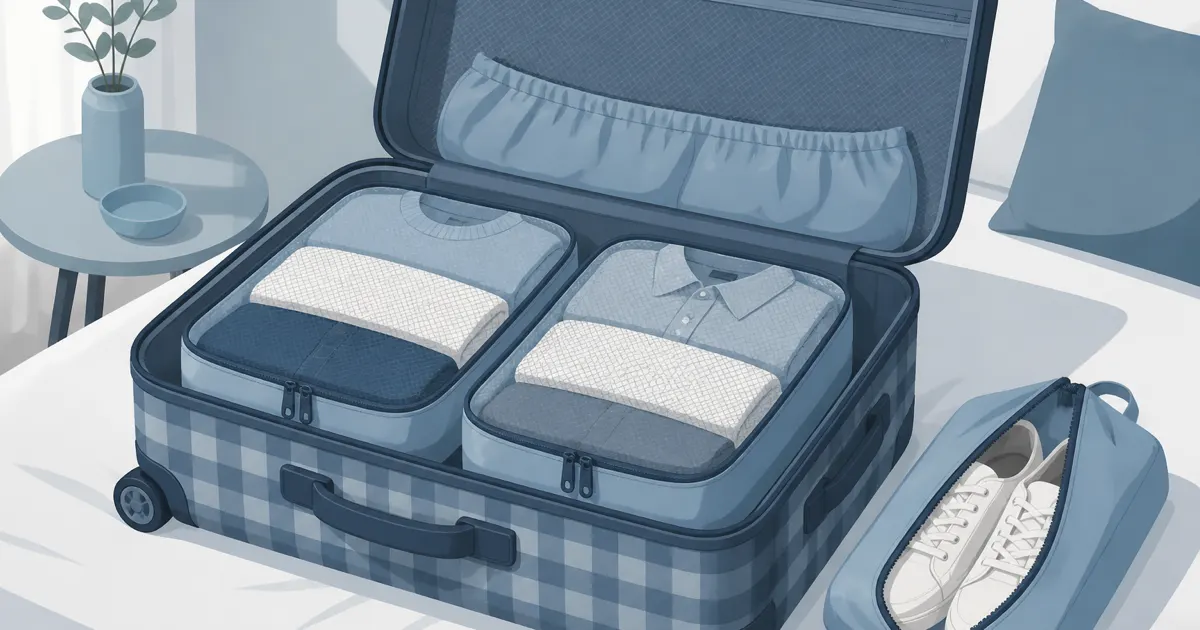
Best Packing Cubes for Checked Luggage: Fill a Large Suitcase Without Chaos
Packing cubes
Large checked suitcases work better with several medium packing cubes than two oversized blocks. Keep weight balanced, isolate shoes, and leave one flexible zone for laundry.
Our picks
The best packing cubes for checked luggage are medium and large organizers you can move around shoes, wheel housings, and a laundry bag. The Dot&Dot Large five-piece set is the one we would start with: five cubes at 17.5 by 12.75 by 3.25 inches, about 11.9 liters each, for $29.99. Use compression for bulky soft clothes, keep dense items near the wheels, and weigh the suitcase before you leave.
Start with our guide to the best way to pack a suitcase for the overall order. If volume is your main concern, compare materials in best compression packing cubes. The packing cubes category gathers the rest.
A large suitcase can hide a bad layout. There is enough room to keep adding clothes, but the bag becomes heavy, unbalanced, and difficult to reopen during the trip. Packing cubes help when they divide the space into useful zones instead of simply helping you fit more.
Why do large and medium cubes work better in a checked case?
A checked case gives you depth, wheel housings, and a lid that folds. One giant cube ignores all three: it becomes a heavy block that you cannot lift in a small hotel room and that leaves the corners empty.
Two or three cubes that fit around the obstacles use the space better, and you can lift one without unseating the rest. That is the whole argument for a size mix in a big bag.
How much of a checked suitcase do cubes fill?
Five large cubes at 17.5 by 12.75 by 3.25 inches are about 11.9 liters each, so the set holds about 59 liters. A big 28-inch checked case is roughly 90 to 105 liters, so the cubes fill about two-thirds of it with clothing and leave the rest for shoes, toiletries, and the return trip.
Each figure comes from the listed 17.5 by 12.75 by 3.25 inch size of the Dot&Dot Large cube.
How much do packing cubes add in weight?
Not much, and it is not the number that matters. The clothes weigh the same whether they travel in cubes or loose. Compression removes air, not mass, and the space it frees is space most people fill. Weigh the packed case at home and leave a margin for gifts.
Which packing cubes are best for checked luggage?
Three sets, three jobs. Buy the Dot&Dot set to fill the case, add the BAGSMART set if soft bulky layers are the problem, and use the Veken set to sort the small stuff and take the laundry home.
Main pick: Dot&Dot Large Packing Cubes (5-piece)
The Dot&Dot Large Packing Cubes (5-piece) are our main checked-bag choice. The cubes are big enough to carry folded pants and jeans, the mesh top keeps the contents visible, and the same-size format stacks cleanly across the base of a large case. More than 5,300 buyers rate it 4.4 stars, and the load is rated at 50 pounds.
Buyers praise the organization and the value. The honest tradeoff is that one size fits all here: dress shirts and socks both land in a large cube unless you add a smaller one. Add a small cube or a laundry bag if you want fine sorting.
Who it is for: Travelers who pack a large checked case and want one clear grid of clothing zones.
Skip if: You need compression for bulky layers. Add the BAGSMART set for that job.
How much does the five-piece set hold?
About 59 liters of clothing across five cubes. A 28-inch checked case is roughly 90 to 105 liters, so the set covers the clothing share and leaves room for shoes, toiletries, and whatever you buy on the trip.
Best compression: BAGSMART Compression Packing Cubes
The BAGSMART Compression Packing Cubes handle the bulky end of a checked bag. Compression zippers squeeze soft layers, and the set is sold in 2, 4, 6, and 14 piece options, which is more useful than a fixed bundle because a checked case needs fewer, larger cubes than a carry-on.
More than 13,500 buyers rate it 4.6 stars, and the first-available date is June 2023, so the line is current. At $28.57 on the six-piece Lightning Deal, that is about $4.76 a piece.
Who it is for: Cold-weather trips, bulky knitwear, and anyone checking a bag who wants to buy only the sizes they use.
Skip if: You want a starter set for warm-weather clothes. The Veken 8 Set covers more zones for less.
Do compression cubes help in a checked bag?
Yes, on soft layers. Compression removes air from sweaters, fleece, and puffer jackets, so a stack gets thinner. It does nothing for weight, and it makes a dense brick that fits a rigid case better than a soft duffel.
Laundry companion: Veken 8 Set Packing Cubes
The Veken 8 Set Packing Cubes make a good companion setup when clean-and-dirty separation matters more than compression. Four sizes and a laundry bag split the small items out from the large cubes. More than 34,000 buyers rate the line 4.6 stars, and at $17.99 for eight pieces that is about $2.25 a piece.
The mesh cubes make clothing easy to identify, and the included laundry bag gives worn items a separate place. Standard cubes do not reduce volume, so use it for sorting, not for saving space.
Who it is for: Travelers who want small-garment zones and a laundry plan without spending much.
Skip if: Bulky soft layers are your problem. Compression does that; standard cubes do not.
Why add a laundry bag to a checked case?
Because worn clothes take more room than the careful folds you started with. A dedicated bag collapses on the way out and fills the space the clean clothes vacated, so the return pack is easier than repacking a mixed cube.
How do you keep weight close to the wheels?
A checked roller should carry its densest items near the wheel end. Shoes, toiletry bottles, and heavy folded pants belong low in the case. Lighter clothing cubes can sit toward the handle end, which keeps the suitcase stable when it stands upright.
How much should you weigh before you leave?
Weigh the packed case at home, not at the airport, and leave a margin for gifts. Spread weight across both halves of a clamshell case: if one side holds shoes and toiletries, the other can hold the denser clothing cube. Do not put every heavy cube in the lid, where it can pull the case over when you open it.
How do you separate shoes and toiletries?
Shoes should go in a dedicated bag, not a clothing cube. A shoe bag is easier to wipe and keeps soles away from clean fabric. Place shoes heel to toe along an edge or near the wheels, then fit the large cubes around them.
Our best shoe bags for travel guide covers simple washable options. Stuff socks inside clean shoes if you need the space, but keep delicate items away from the heel.
Toiletries deserve their own leak-resistant kit. Checked luggage allows larger containers, but loose full-size bottles do more damage when they leak. Tighten caps, isolate risky liquids, and keep the toiletry bag away from a soft clothing cube.
When should you plan the laundry zone?
Before you leave. Pack an empty laundry bag along the hinge, or start one cube partly empty. Worn clothes expand as they lose their folds, so the return layout needs more flex than the outbound one.
Keep dry laundry together. Let damp swimwear or workout clothes air before packing, then use a separate water-resistant pouch if they must travel damp. A sealed compression cube is a poor place for wet fabric. The best travel laundry bag guide covers breathable and compression options.
How do you pack for access during the trip?
Think about what you need first. Put pajamas, underwear, and the next day's clothes in a cube near the top. Bulky items you will not use until later can sit deeper in the case.
If you are changing hotels, divide cubes by clothing type rather than by suitcase half, so you can pull the tops cube without opening every bag. For a resort stay where you unpack once, a broader spread of category cubes matters less.
Do not place medication, passports, keys, or essential electronics in checked luggage. Cubes organize the case, but they do not prevent a delay or a lost bag. Keep critical items in your personal item.
What mistakes do people make with cubes in a checked bag?
- Using two oversized cubes that become too heavy to handle
- Filling every piece from a large set because it shipped in the box
- Compressing the suitcase past the airline weight limit
- Packing shoes loose against clean clothes
- Sealing damp laundry in a compression cube
- Putting all the dense items in the lid half of a clamshell case
Take a quick photo of the finished layout. It helps when repacking in a hotel and makes it easier to notice when one category has grown beyond its original space.
Final takeaway
The best packing cubes for checked luggage create several movable zones and keep the suitcase balanced. The Dot&Dot Large Packing Cubes (5-piece) fill a big case in one clean grid, BAGSMART Compression Packing Cubes squeeze bulky soft layers, and the Veken 8 Set adds small-garment zones and a laundry bag. Use medium and large cubes, isolate shoes and toiletries, keep dense items near the wheels, and save room for the return trip.
Frequently Asked Questions
What size packing cubes work in checked luggage?
Large and medium cubes are the most useful. Five large cubes at 17.5 by 12.75 by 3.25 inches hold about 59 liters together, which fills most of a big case. Place them across the base, then use a small cube for socks and underwear.
Do packing cubes make checked luggage heavier?
They add ounces, not pounds, but they make overpacking easier. Compression removes air, not weight. Weigh the suitcase after packing because the space you save is space people fill.
Does TSA allow packing cubes?
Yes. Screened bags get opened, so pack the case so a search is not painful. Keep the deepest, most private items easy to see and do not wedge a cube so tightly that an officer has to empty the suitcase.
Should shoes go in packing cubes?
Use a separate shoe bag. Clothing cubes are harder to clean, and shoe soles should not touch clean clothes.
How should I balance a checked suitcase?
Put shoes and dense items near the wheel end. Spread medium clothing cubes evenly and avoid stacking every heavy item on one side of a clamshell case.
Should I use compression packing cubes in checked luggage?
Compression helps with soft, bulky items such as sweaters. It does not reduce weight, so leave the suitcase some flex so the seams are not stressed during handling.
Where do dirty clothes go in a checked suitcase?
Pack an empty laundry bag along the hinge or start one cube partly empty. Worn clothes take more room than the careful folds you started with, so the return layout needs extra space.
What are the highest rated packing cubes?
High ratings are common in this category, so read the size list instead of the star count. The sets worth buying publish piece dimensions, include a laundry plan, and use two-way zippers.