Suitcase Capacity Calculator
Pick your bag size and cube size to see the usable volume, how many cubes fit, and what is left over before you pack.
| Bag | Volume (L) | Usable (L) | Cubes |
|---|---|---|---|
| Underseat 18 x 14 x 8 in | 33.0 | 28.1 | 4 |
| International carry-on 21 x 14 x 9 in | 43.4 | 36.9 | 5 |
| Domestic carry-on 22 x 14 x 9 in | 45.4 | 38.6 | 5 |
| Checked 27 x 18 x 11 in | 87.6 | 74.5 | 11 |
How to read your suitcase size
Suitcase makers list outside dimensions, so the interior is always a little smaller. Wheels, handles, and the fabric wall eat into the space. The calculator takes the listed length, width, and height, converts them to liters, then keeps about 85 percent as usable room. That leaves a sensible cushion for the parts of a real bag you cannot pack into.
Which cube size fits your trip
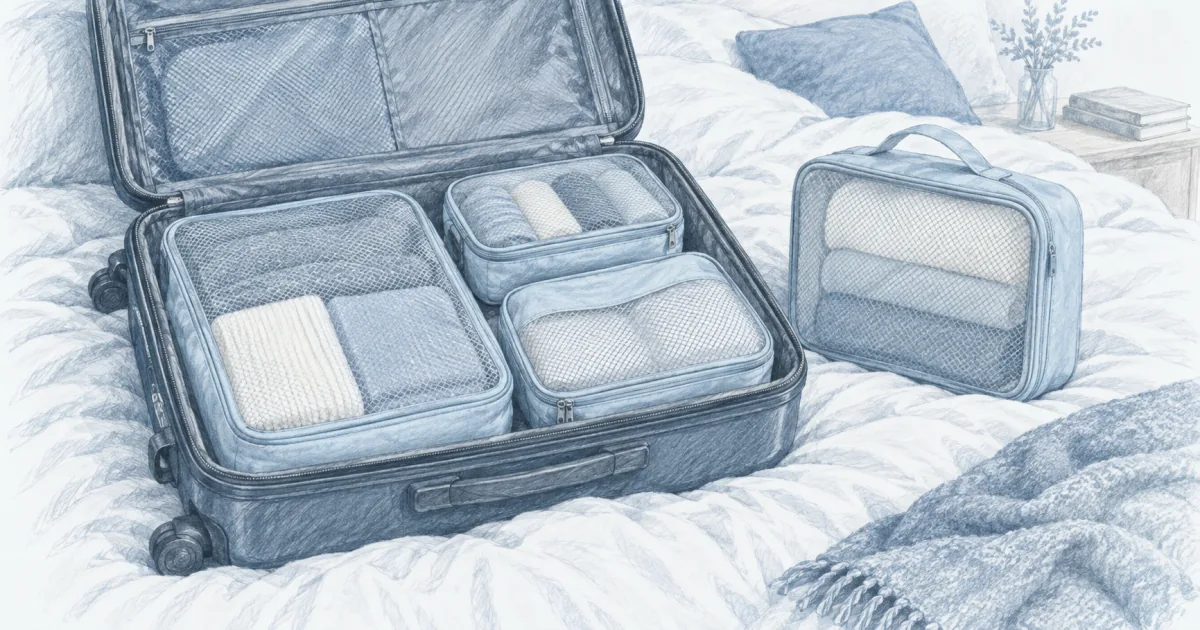
Slim cubes suit socks, underwear, and cables. Standard cubes hold a few tops or folded pants. Large cubes swallow jackets or a full week of soft clothes. Measure your bag once, note how many standard cubes fit, and build the same layout every trip instead of guessing at the airport.
Soft bags, hard shells, and leftover space
A fabric duffel or soft suitcase can bulge past its listed size, so you may squeeze in a little more than the usable figure. A hard shell keeps its shape and holds close to the number here. Either way, the leftover liters after whole cubes are where you tuck loose items: a dirty laundry bag, a pair of sandals, or a rain shell.
Our picks
Questions about this calculator
What is the capacity of a carry-on suitcase?
A domestic carry-on around 22 by 14 by 9 inches works out to roughly 45 liters of internal volume and about 38 liters of usable space. International carry-ons are a touch smaller at about 43 liters. Always check the exact size limits for your airline before you buy.
How many packing cubes fit in a carry-on?
A domestic carry-on fits about five standard 6.5 liter cubes after the usable-space cushion. With slim 2.4 liter cubes you can fit far more, because each one takes less room. The table above shows the count for every bag and cube size.
How do I calculate suitcase volume in liters?
Multiply length by width by height in inches to get cubic inches, then multiply by 0.0163871 to convert to liters. For example, 22 by 14 by 9 inches is 2,772 cubic inches, which is about 45 liters.
Do listed suitcase dimensions include the wheels?
Sometimes. Many brands list the case body alone, while airlines measure the whole bag including wheels and handles. If the listing does not say, assume the number is the body and allow for wheels when you compare against an airline limit.
Why use 85 percent as usable space?
No suitcase packs to its full geometric volume. Zippers, seams, handles, and the shape of clothes leave gaps. Keeping 15 percent back gives a realistic target so you are not planning a layout that cannot close.
Do packing cubes reduce the volume of my clothes?
Regular cubes organize without shrinking anything. Compression cubes can pull soft bulk down by squeezing out air, which helps with jackets and knits. Neither makes an oversized packing list fit.
Can a large 12 liter cube fit in a carry-on?
It can, but a single large cube can fill a big share of the bag and force the lid to dome. For carry-ons, a mix of standard and slim cubes usually stacks better than one or two large cubes.