Best Travel Door Lock (2026): 4 Portable Locks for Hotel Rooms
Organizers
A travel door lock adds a second lock to a hotel, rental, or dorm door you do not control. Start with the VIRIDI for most doors, step up to the Addalock for the original two-pack, choose the Guard Dog Blocklock for a wider strike-plate fit, or the DoorJammer when the door has no strike plate to hook.
Our picks
A hotel room door is only as strong as the lock someone else controls. Staff have master keys, past guests may have kept a code, and a rental host may have a spare. A portable door lock adds a second lock that only works from inside the room, so a key or a code is not enough to get in while you are there.
The trick is that not every portable lock fits every door. Claw-style locks need a gap at the strike plate. Floor-brace bars need clearance under the door and a floor with grip. Once you know which one your door can take, the choice is simple. For most travelers that lock is the VIRIDI below: it uses the same strike-plate design as the well-known Addalock, packs into a pouch, and costs less per lock. Any of the four here costs less than a single night of hotel parking.
This guide sits with the rest of the security gear in the organizers section, next to the TSA luggage locks that protect a checked bag and the RFID passport holder that keeps documents safe. The cable organizer pillar covers the tech pouch that these small tools usually end up sharing.
Quick comparison
The four picks at a glance
How do you know a travel door lock will fit your door?
Look at the frame where the door closes. Find the small metal plate the latch sits in, called the strike plate. Slide a coin into the gap between the door and the frame near that plate. If the coin fits, a claw lock will seat. If it does not, plan on a floor bar.
The coin test, step by step
Stand inside the room and close the door. Find the strike plate on the frame. Slide a coin into the gap just above or below the latch. On the Addalock, the maker's own test is this coin gap, and it works out to about an eighth of an inch. Most hotel and apartment doors pass. A door that closes tight against the frame with no gap is the one that fails.
What if the strike plate is odd or painted over?
Then you want a lock that seats into a different hole or a lock that ignores the plate. The Guard Dog Blocklock has two strike-plate hole sizes, so an older plate that a single-hole claw misses can still work. If the plate is buried under paint or set flush, switch to the DoorJammer floor bar, which does not use the plate at all. A floor bar needs about 0.25 to 1.5 inches of clearance under the door.
Top pick: VIRIDI Portable Door Lock
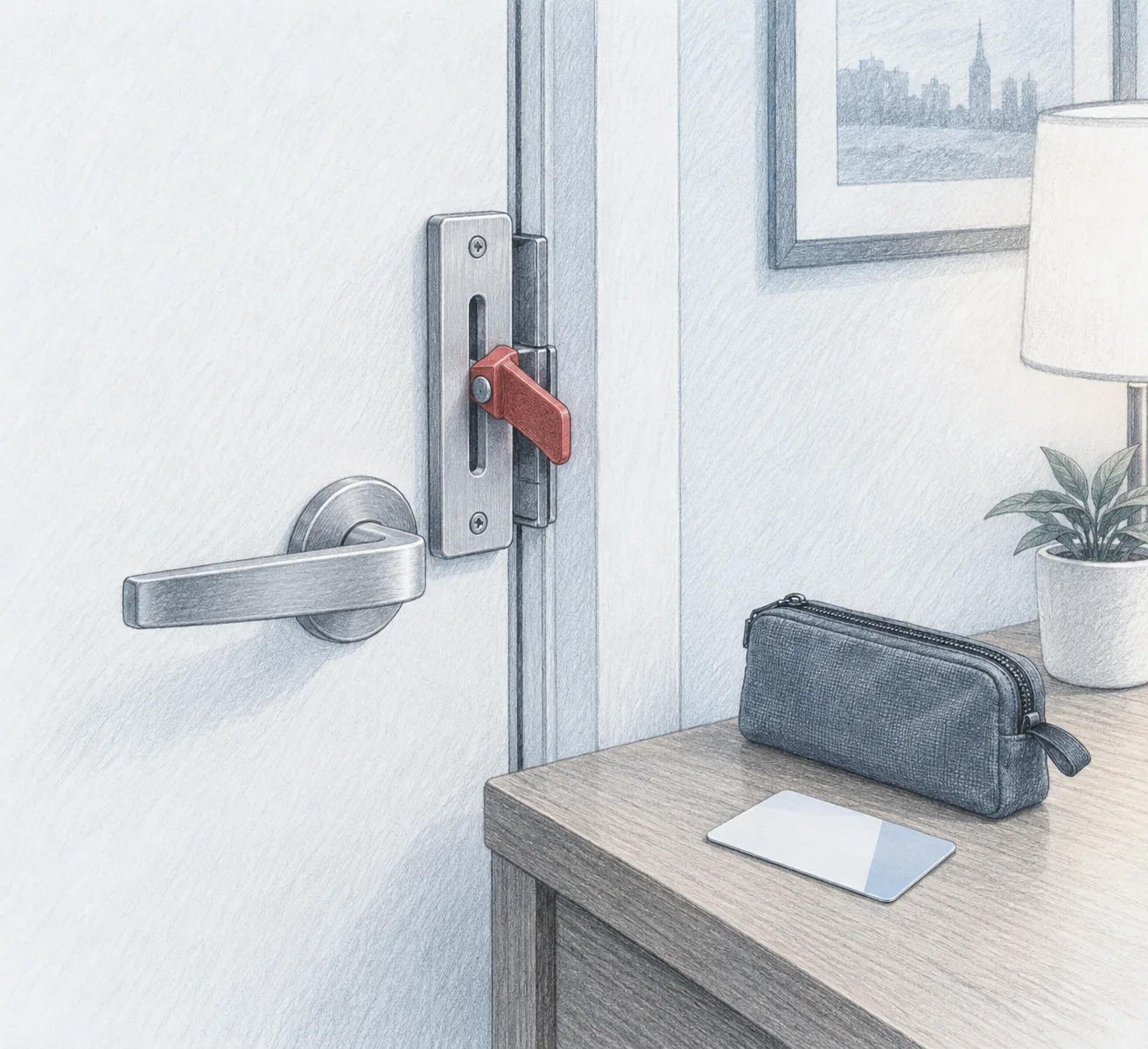
The VIRIDI does the same job as the Addalock for less money. You hook its claws into the strike plate on the frame, close the door to trap the body, and slide the red handle down to wedge it in place. Because it braces at the frame instead of the latch, the room's own deadbolt or key card stops mattering while you are inside.
The build is simple on purpose. The plate is stainless steel, the handle is molded plastic around a metal rod, and the whole package weighs about as much as a deck of cards. The fit gauge printed on the handle back is the detail a lot of cheap locks skip, and it tells you whether a door will work before you try to seat anything. It is one lock, not a pair, so a room with a connecting door means buying two.
Skip it if you want a spare in the same box or you prefer the original brand name. Pick it for almost every hotel, Airbnb, dorm, or apartment door.
Best proven original: Addalock The Original Portable Door Lock
The Addalock is the original, and it is still the pick if you want the name and a spare. It solves the job the same way as the VIRIDI, hooking its claws into the strike plate and bracing against the frame, and it does not care whether the door's own latch or deadbolt works.
The build is deliberately simple. The metal body and handle are a bit heavier than the price suggests, and the red handle is red on purpose so you can find it in the dark. A two-pack is the common buy because it covers a room with a connecting door, or lets you leave one at a relative's house.
The limit is the gap. The brand's own test is to slide a coin between the door and the frame. If it fits, the Addalock fits. If the door closes tight with no gap at all, you need the DoorJammer instead. That is the only real catch.
Skip the Addalock if you want the lowest price or your door has no gap at the frame. Pick it when you want the original and two locks in one buy.
Best for a wider fit: Guard Dog Security Blocklock
The Blocklock does the same job as the two locks above with one design change that helps on a wider range of doors. It has two different-sized holes for the strike plate, so you can pick the one that seats cleanly instead of forcing a single hole.
It is made from stainless steel with an electroplated, polished finish, and it carries a lifetime warranty. At just over six inches long and under half a pound, it disappears into a side pocket. The setup is tool-free: insert the metal plate into the strike slot, close the door, and hook the handle groove over the stud.
The tradeoff is feel and price. Owners report it can be stiff for weaker hands, and the maker warns it may not sit snugly on doors that close very tightly. It also costs more than the VIRIDI, so pick it for the fit range rather than the savings.
Skip it if you have weak grip or a very tight door. Pick it when your strike plate is an odd size and a single-hole lock will not seat.
Best for doors with no strike gap: DoorJammer
The DoorJammer solves the door that defeats a claw lock. Instead of hooking the strike plate, it sits below the handle and braces against the floor, so it does not need a gap at the frame at all. That makes it the pick for older buildings, thick-painted doors, and rentals where the strike plate is buried.
The design is compact at about 4.5 by 3.5 inches, and it ships with a set of spacer keys plus a neoprene extension foot for thick carpet. Setup is a twist of the screw once it is positioned, and the quick release pulls up and out if you need to leave in a hurry.
The honest limit is the floor. It holds firmly on hard floors and slips on carpet and linoleum without care. Use the neoprene foot on carpet, and avoid it on a slick floor where a claw lock would work anyway.
Skip it on slick floors. Pick it when the door has no usable strike plate and you need a brace that does not rely on one.
How does a claw lock compare to a floor brace?
A claw lock hooks the strike plate and braces at the frame. A floor brace wedges under the handle and pushes against the floor. Claw locks are faster and fit more doors. Floor braces work when the plate is too tight to grab and hold better when the frame has no gap.
Which is faster to set up?
The claw locks set up faster. A VIRIDI or Addalock seats in a few seconds once you know the motion. The DoorJammer takes longer because you position it, twist the screw, and test the grip. On a midnight arrival, that difference is real, which is why the claw locks are the default and the floor bar is the backup for hard cases.
What about a doorstop wedge or a chair?
A rubber wedge is not a real substitute. It only resists friction, so it slides under steady pressure from the hallway, and a chair under the handle is easy to push aside because it has no anchor. A claw lock pushes back against the frame, and a floor bar pushes back against the floor. Those two have something solid to fight against, which is why they are the picks here.
Can you fly with a portable door lock?
Yes. It is a small metal tool, not a prohibited item, so it travels in a carry-on or personal item. The metal can slow an X-ray bag check, so keep it in an outer pocket rather than buried under clothes. Do not put it in a checked bag, where the small piece can vanish with a delayed suitcase.
What mistakes do people make with portable door locks?
Buying a claw lock for a door with no gap. If a coin will not slide between the door and frame, the claws have nothing to bite. Pack a floor-brace bar instead.
Using it as a lock-and-leave device. These protect you while you are in the room. They do nothing for your belongings after you leave, so use the room safe for valuables.
Forgetting to test it. Set the lock and push the door the first night. You want to find a fit problem before you are tired and the lights are off.
Ignoring the floor. A brace bar that slips on tile gives false confidence. Match the lock to the floor, or use a claw lock when the frame allows it.
Packing it where you cannot reach it. Keep the lock and its pouch in an outer pocket. A metal tool buried in a packed bag is a slow security line and a slow setup at midnight.
Assuming it works on every door. Sliding, double, and outward-opening doors are out. Check the door direction before you buy.
Final takeaway
For most trips, the VIRIDI Portable Door Lock is the best travel door lock. It braces the frame, holds against a key, and costs less than the better-known names. Step up to the Addalock The Original for the proven two-pack, choose the Guard Dog Security Blocklock when your strike plate needs a wider hole, or the DoorJammer when the door has no strike gap and you are standing on a carpeted floor.
Run the coin test on your door before you buy, learn the release motion with the lights on, and keep the lock in an outer pocket. Pair it with the TSA luggage locks for your checked bag and an RFID passport holder for documents, then keep the whole security kit together with the organizers section.
Frequently Asked Questions
What is the best travel door lock for most trips?
The VIRIDI Portable Door Lock is the best travel door lock for most hotel and rental doors. It hooks into the door's strike plate and braces the door from the inside, so it holds even if someone else has a key, and it costs less than the better-known Addalock. It packs into its own pouch and fits most inward-swinging doors.
How do I know a portable door lock will fit my door?
Hold a coin between the door and the frame near the latch. If the coin slides in, there is enough gap for the VIRIDI or the Addalock. Most hotel and apartment doors pass this test. Doors that close very tight against the frame are the ones that fail.
Does a portable door lock work if the door has no lock?
Yes. A strike-plate lock like the VIRIDI, the Addalock, or the Guard Dog Blocklock does not use the door's own latch or deadbolt. It braces against the frame, so it adds security to a door that has no working lock at all.
Will a travel door lock work on an outward-opening door?
No. Portable door locks are built for inward-opening hinged doors, which covers almost every hotel room, Airbnb, and apartment entry door. They do not work on sliding, double, or outward-opening doors.
Can I bring a portable door lock in a carry-on?
Yes. It is a small metal tool, not a prohibited item, so it goes in a carry-on or personal item. It can slow a security bag check because of the metal, so keep it in an easy-to-reach pocket rather than buried at the bottom.
Do I leave a portable door lock on when I leave the room?
No. These are lock-and-stay devices, not lock-and-leave devices. You set one from inside the room while you are there, then remove it before you leave. They protect you in the room, not your belongings after you go.
What is the difference between a claw lock and a floor-brace bar?
A claw lock hooks into the strike plate and braces the door at the frame. A floor-brace bar wedges under the handle and against the floor. Claw locks are faster and fit more doors; floor bars work when the strike plate is too tight and slip less on a hard floor.
Is a portable door lock better than a doorstop wedge?
For security, yes. A rubber wedge only resists friction and slides under pressure. A claw lock or a brace bar pushes back against the frame or the floor, which is much harder to defeat from the hallway.