Best Travel Power Strip (2026): Cruise-Safe and Surge Picks
Organizers
A travel power strip is how two phones, a laptop, and a camera all charge from one hotel socket. Start with the Anker Nano 67W, choose the NTONPOWER for cruises, or the One Beat for a desk.
Our picks
A travel power strip fixes the oldest hotel-room problem: one working outlet and four devices that need it. Instead of balancing chargers on a nightstand, you plug in one strip and charge everything from a single spot. The strip also gives you a place to park the cables, which matters more than people expect in a cramped cabin or an older European room.
The catch is that not all power strips are travel-friendly. Surge protection, the thing that protects a home office, is exactly what cruise lines ban aboard ships. So the pick depends on where you are going. For most hotel trips the Anker Nano is the default. For a cruise, the NTONPOWER is the right tool. For a desk or a rental with questionable wiring, the One Beat.
If you are also converting plug shapes, pair the strip with the right adapter for the region: Europe, the UK, or Japan. The organizers section collects the rest of the tech guides, and the cable organizer pillar covers how to carry the cords.
Quick comparison
Top pick: Anker Nano 67W 6-in-1
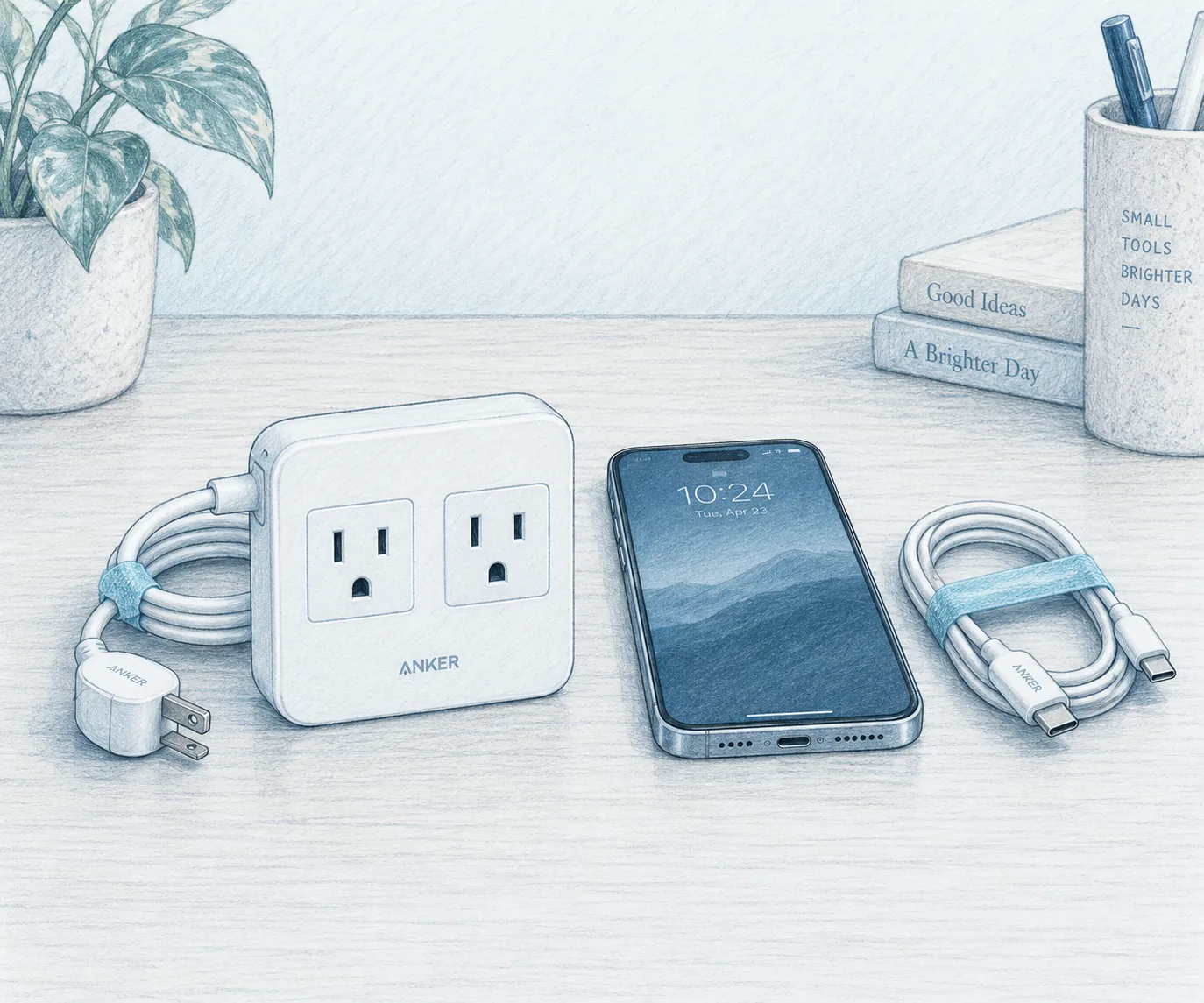
The Anker Nano is the most useful strip for a normal trip because it does two jobs in one package. It splits one outlet into two AC sockets, and it adds four USB ports including a 67W USB-C that can charge a laptop. That means you can leave the laptop brick at home and use the strip as the charger for the whole crew.
The physical design is what makes it packable. It measures about 3.94 by 3.66 inches and less than an inch thick, with a flat plug and a 5-foot cord that reaches an outlet behind a bed or a dresser. The two AC outlets are on the face, where they are easy to reach, and the USB ports sit along the edge. At under a pound, it adds almost nothing to a bag.
There are two tradeoffs. The cord is not detachable, so packing is a coil rather than a clean break. And the USB ports share power when all four are busy, so a laptop gets more if you leave a slot free. For travel use that is a fair trade.
Skip the Anker if your only concern is cost and you charge phones overnight. The NTONPOWER does that for less. Pick the Anker if a laptop is part of your kit.
Best budget and cruise pick: NTONPOWER Travel Power Strip
The NTONPOWER is the pick when cruise rules rule out a surge protector. It delivers three AC outlets and four USB ports with no surge circuitry, so it meets the requirement most major lines set for power boards. Carnival, Princess, Norwegian, Holland America, and Virgin Voyages are among the lines that allow non-surge strips. Disney, Royal Caribbean, Celebrity, and MSC take a stricter line, so check your line's list before you sail.
The wrap-around design is the travel detail that earns it a spot. The 4-foot cord coils around the body, so the whole strip stays compact in a bag and does not unspool into a knot. It is about the footprint of a coaster and less than an inch thick, so it fits a side pocket.
The limit is speed. The USB ports share 15.5W, which is fine for a night of phone charging and slow for a laptop. If a laptop is coming, pair this strip with the laptop's own charger in one of the AC outlets.
Skip it if you want a laptop fast charger built in. Pick it if you are cruising or you want a cheap, tidy strip for phone charging.
Best for a desk or hotel room: One Beat 900J
The One Beat is the desk pick, not the ship pick. It has six AC outlets spaced wide enough for bulky power bricks, plus four USB ports, and it adds 900 joules of surge protection. That protection is useful in an older hotel room or a rental with dodgy wiring, where a spike can take out a charger or a laptop.
The flat plug and the 5-foot cord make it easy to place. The plug profile is low enough to sit behind a dresser, and the cord reaches the outlet that is always hidden behind the bed. It is also the cheapest pick here, which makes it a sensible second strip to keep in a travel bag for land trips.
The warning is clear. Surge-protected strips are what cruise lines confiscate, and community reports describe units being taken at embarkation. If your trip includes a ship, pack the NTONPOWER instead. Keep the One Beat for hotels, apartments, and the home desk.
Skip it for cruises. Pick it for a long hotel stay or a work trip where you want surge protection and lots of outlets.
Surge protection and why cruise lines care
A surge protector absorbs voltage spikes so they do not reach your devices. On land, that is a small insurance policy. At sea, the extra circuitry is a different story. Marine wiring is not grounded the way a building is, and a surge device that tries to divert a spike has nowhere safe to send it. That is why cruise lines ban surge-protected strips and power boards.
The practical rule is simple. If you are sailing, pack a strip with no surge protection. If you are staying on land, surge protection is a plus. The labels are not always obvious, so read the product page for the words "surge protection" or a joule rating. The three picks here split cleanly: two surge-free, one with 900 joules.
Also watch the word "extension cord." Some lines ban extension cords outright as well as surge boards, and a strip with a long cord can be caught by that rule. A short-cord, surge-free strip is the safest bet, and a multi-plug outlet expander is the fallback if your line is strict.
How to use a travel power strip abroad
A US power strip does not change voltage and does not change plug shape. To use it in Europe or the UK, plug the strip into a travel adapter and then plug your devices into the strip. That gives you one conversion point at the wall and several outlets at the strip.
Check the strip's voltage rating before you do this. The USB side of these strips typically accepts 100 to 250V, which is what makes the adapter trick work. The AC outlets are a different matter. They are usually rated for US current and voltage, so do not run a high-power appliance through a US strip on a 230V circuit.
Keep the load modest. Phones, laptops, tablets, cameras, and power banks all draw little and are fine. Hair dryers and other heating tools draw a lot and belong on a dual-voltage tool or a converter, not on a travel strip.
Packing and cable habits that keep the strip useful
Coil the cord around the strip or use the wrap-around design, then secure it so it does not unspool in the bag. A strip with a loose cord tangles with every other cable in the pouch. Keeping it in one spot makes it the charging hub rather than another mess.
At the hotel, put the strip on the desk or the nightstand and leave the chargers plugged in. That turns a single wall socket into a dock you can reach without crawling behind furniture. If the strip has a flat plug, use it behind the bed or the dresser where a normal plug will not fit.
Roll the whole kit into a cable organizer or a tech pouch so the strip and its cables travel together. A strip without its cords is just a brick, and the cords are the part that goes missing.
Common mistakes with travel power strips
Taking a surge protector on a cruise. It may be confiscated, and it is a genuine fire concern aboard a ship. Pack a surge-free strip.
Assuming a US strip converts voltage. It does not. Use an adapter at the wall and keep high-power appliances off the strip.
Daisy-chaining with an extension cord. Plugging a strip into an extension cord risks an overload. Go straight into the wall.
Buying a strip with a short cord for a hotel room. Outlets hide behind beds and dressers. A 4- or 5-foot cord is worth the extra few inches.
Loading every port at once and expecting full speed. USB ports share power. Leave a slot free when a laptop needs the most.
Forgetting the strip in a checked bag. Keep it in the cabin so you can charge at a layover and so it does not get lost.
Final takeaway
For most trips, the Anker Nano 67W 6-in-1 is the best travel power strip. It packs slim, adds two outlets and four USB ports, and its 67W USB-C port can charge a laptop. Choose the NTONPOWER when you are sailing, because it is surge-free and packs tidy. Choose the One Beat 900J for a hotel desk, a rental, or a home office where surge protection helps.
Then match the strip to the wall with the Europe adapter or UK adapter guide, and keep the whole charging kit together with the cable organizer pillar.
Frequently Asked Questions
What is the best travel power strip for most trips?
The Anker Nano 67W 6-in-1 is the best travel power strip for most trips. It has two AC outlets, four USB ports, a 5-foot flat cord, and a 67W USB-C port that can charge a laptop. It is slim enough to pack in a laptop sleeve. For cruises, choose the NTONPOWER because it has no surge protection.
Do cruise ships allow power strips?
Some do, but only if they have no surge protection. Cruise lines ban surge-protected strips because the extra circuitry can overheat on marine wiring. The NTONPOWER and the Anker Nano are surge-free. The One Beat in this guide has 900 joules of surge protection, so leave it home on a cruise.
What is the difference between a power strip and a surge protector?
A power strip adds outlets. A surge protector adds outlets plus a circuit that absorbs voltage spikes. The surge part is what cruise lines care about. For a hotel or a home desk, surge protection is a plus. For a ship, it is the wrong tool.
Can I bring a power strip in a carry-on?
Yes. A power strip is not a prohibited carry-on item. Keep it in your carry-on or personal item like any other cord, and check the cruise line rules before you sail because some lines treat power boards differently from extension cords.
Does a travel power strip work in Europe or the UK?
Not on its own. A US power strip needs a plug adapter to fit a European Type C or UK Type G socket. The strip itself is usually fine with 100 to 250V, but check the label. The ones here list wide-voltage input for the USB side, and the AC outlets are still rated for US current, so do not plug high-power appliances into a US strip abroad.
How many watts do I need from the USB ports?
About 20W covers a phone fast, and 67W or more covers a laptop. If you only charge phones and earbuds at night, a strip with 15 to 22W of shared USB output is enough. If a laptop shares the strip, look for a 65W or 67W USB-C port.
Is a power strip or a plug adapter better for travel?
They solve different problems. A plug adapter changes the shape of the plug to fit the wall. A power strip multiplies one outlet into several. On a longer trip you often need both: an adapter for the wall and a strip to split that single converted outlet.
Can I plug a power strip into an extension cord?
No. Chaining a power strip and an extension cord is called daisy-chaining, and it can overload a circuit and create a fire risk. Plug the strip directly into a wall outlet, and use its own cord to reach the standing lamp or the far side of the room.