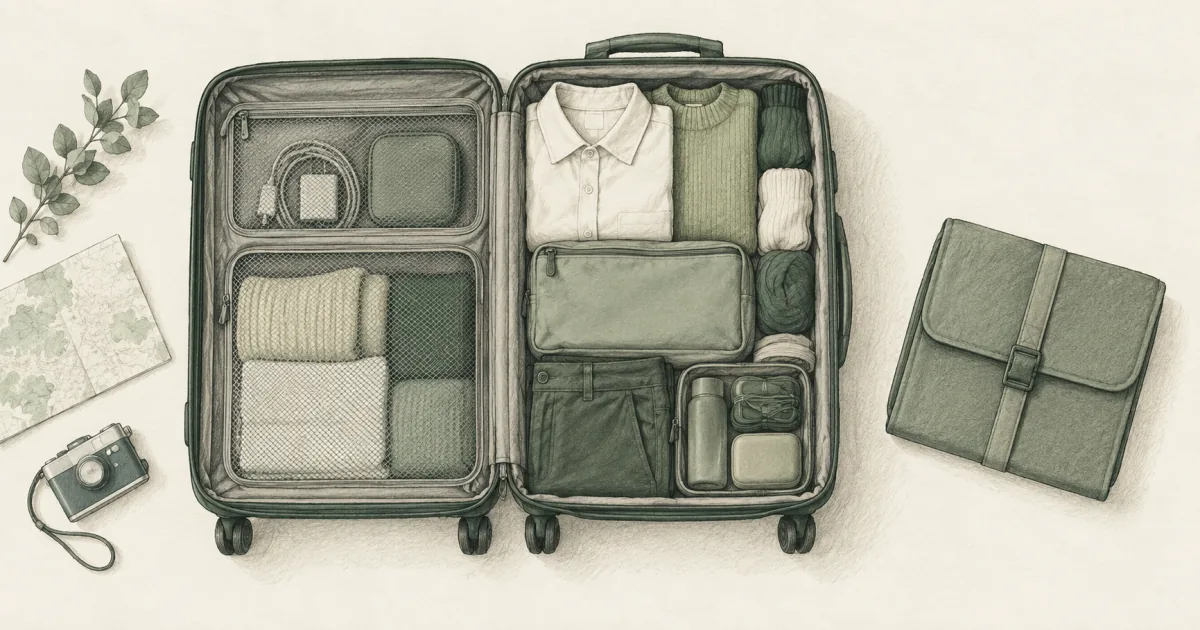
Best Carry-On Luggage That Holds the Most (2026): Capacity-First Picks That Still Fit the Bin
Carry-on
The best carry-on luggage that holds the most packs a week-plus of clothes inside the bin, not the hold. Start with the Travelpro Maxlite 5 at 46 liters expanded, then pick the LIGHT FLIGHT hardside at 42 liters expanded if you want a rigid shell with a TSA lock.
Our picks
Buying the highest-capacity carry-on is not about finding the bag with the largest number on the spec sheet. It is about finding the bag that holds the most clothes while still fitting the airline bin and still meeting the airline weight cap. A 60-liter "carry-on" that overshoots the bin limit gets gate-checked and the capacity is wasted. A 30-liter bag under the airline limit holds less than it should because loose clothes do not use the full internal volume.
This guide ranks carry-ons by capacity that still meets bin limits, with a capacity-to-weight ratio that does not eat the airline's weight cap on a regional jet. For the broader carry-on guide, the gender-focused buying view, or the international flight focus, start there. For a backpack instead of a spinner, see best travel backpack. Pair the bag with compression packing cubes so the internal volume goes to clothes, not air.
A capacity-first carry-on fails most often when the bag is one inch too deep for the airline bin, when the empty weight eats the weight cap, or when the bag has no internal organization so clothes compress unevenly. Buy inside the airline's dimensions, weigh the bag at home, and pack with cubes. That is the whole job.
Quick comparison
Best capacity overall: Travelpro Maxlite 5 21-Inch
The Travelpro Maxlite 5 21-Inch is the best carry-on luggage that holds the most for travelers who also care about empty weight. At 23 by 14.5 by 9 inches, the bag fits inside most US domestic and EU bin limits. Expanded, it hits 46 liters, the largest mainstream softside capacity in this price range. Empty weight is 5.4 pounds, the lightest mainstream carry-on in its class.
The capacity-to-weight ratio is the headline. The Maxlite 5 delivers 8.52 liters per pound of empty bag weight; the LIGHT FLIGHT hardside delivers about 6.18 liters per pound. On a 15-pound regional-jet cap, the Maxlite 5 leaves 9.6 pounds of bag-and-clothes weight, enough for a week of clothes plus a laptop. The hardside leaves 8.2 pounds.
The two exterior front pockets are the deciding feature. One holds a 15-inch laptop; the other holds a book, a jacket, or the liquids pouch you need to pull at security without opening the main compartment. The PowerScope Lite handle locks at two heights so both 5'2" and 6'0" travelers push it without slouching.
This is the pick if you fly regional jets, want the lightest mainstream carry-on, and need external pockets for laptop and liquids. The lifetime warranty covers the bag for life; the one-year airline-damage promise covers the first year.
Skip if: You want a built-in TSA lock. The Maxlite 5 does not have one. Buy a small TSA lock separately if you have a US connection.
Who it is for: Regional jet travelers, weight-conscious flyers, and anyone who values empty weight as much as capacity.
Pros
- 46 liters expanded with a 5.4-pound empty weight, the best capacity-to-weight ratio in this list
- Two exterior pockets for laptop and security-priority items
- Lifetime warranty plus a one-year airline-damage promise
- 21-inch case fits most US regional jets
Cons
- Softside fabric wears faster than a hard shell
- No built-in TSA lock
- 21-inch case is borderline on the strictest EU carriers
Check the Travelpro Maxlite 5 21-Inch on Amazon
Best capacity hardside: LIGHT FLIGHT 20-Inch
The LIGHT FLIGHT 20-Inch Hardside Carry-On is the best hardside when you want a rigid shell and a built-in TSA lock. At 21.4 by 14.6 by 9 inches, the bag fits inside IATA, most US domestic, and most EU bin limits. Expanded, it goes from 35 to 42 liters, a clear step above the typical 34 to 38 liter hardside carry-on.
The ABS composite shell holds its shape under load. A fully packed hardside uses the full internal volume; softside bags flex and bulge. With cubes, the LIGHT FLIGHT at 42 liters holds a week of clothes, a laptop, a charger, and a small liquids pouch. Without cubes, it holds less because loose clothes do not compress evenly.
The built-in TSA combination lock clears US screening during a connection. The scratch-resistant surface hides the scuffs that show up after a few overhead-bin bumps. The five-year manufacturer warranty covers defects in materials and workmanship but not airline damage.
This is the pick if you want a hardside with a TSA lock and you pack with cubes. Skip it if you want the absolute largest capacity; the Maxlite 5 above holds more.
Skip if: You fly only on European budget carriers with strict 8-inch depth limits. The LIGHT FLIGHT at 9 inches deep will get measured. Switch to a smaller 20-inch bag.
Who it is for: Flyers who want a rigid hardside with a built-in TSA lock, and travelers who pack with cubes.
Pros
- Expands from 35 to 42 liters, among the larger 20-inch hardside capacities in this price range
- ABS composite shell holds its shape under a fully packed cube set
- Built-in TSA combination lock for US connections
- Five-year manufacturer warranty
Cons
- 6.8 pounds empty is heavier than the softside, so capacity-to-weight ratio is lower
- No external pockets, so laptop and liquids live in the main compartment
- 9-inch depth is borderline on EU budget carriers
Check the LIGHT FLIGHT 20-Inch Hardside Carry-On on Amazon
Capacity-to-weight ratio explained
Capacity-to-weight ratio is liters of internal volume divided by empty bag weight in pounds. Higher is better. A bag that delivers 8 liters per pound packs more clothes per ounce of bag. The Maxlite 5 at 8.52 L/lb wins on this metric. The LIGHT FLIGHT hardside at about 6.18 L/lb is lower because the shell weighs more than softside fabric.
For travelers on weight-capped airlines (regional jets, European budget carriers), capacity-to-weight ratio matters more than absolute capacity. A bag that fits 46 liters and weighs 5.4 pounds is more useful than a bag that fits 42 liters and weighs 6.8 pounds, because the lighter bag leaves more weight budget for clothes inside the airline cap.
For travelers on airlines without weight caps (most US carriers), absolute capacity matters more. The Maxlite 5 at 46 liters expanded holds the most in this list, with the LIGHT FLIGHT hardside at 42 liters close behind.
How airlines publish carry-on limits
Airlines publish dimensions, not capacity. A bag that is 22 by 14 by 9 inches fits inside most airline bins regardless of whether its internal volume is 36 liters or 48 liters. Capacity is a manufacturer number that tells you how much fits inside the bag; dimensions tell you whether the bag fits in the bin.
A bag with high capacity and tight dimensions is the goal. The LIGHT FLIGHT at 42 liters in 21.4 by 14.6 by 9 inches is borderline on strict carriers. The Maxlite 5 at 46 liters in 23 by 14.5 by 9 inches is also borderline. If you fly only on the strictest EU budget carriers, look for a bag at 21 by 15 by 8 inches or smaller, and accept that capacity drops to about 38 to 40 liters.
How to pick a high-capacity carry-on
- Check the airline's published dimensions for every leg of the trip. A bag that fits in your outbound airline's bin may be too big for your return. Measure with the wheels extended.
- Aim for 40 to 48 liters. Below 35 liters means a cube stack overflows. Above 50 liters in a 20-inch case usually means overshooting the airline's depth limit.
- Calculate capacity-to-weight ratio. Liters divided by empty pounds. Above 7 L/lb is good for softside; above 6 L/lb is good for hardside.
- Pick a shell that holds its shape. Hardside uses its full internal volume. Softside bulges when overpacked, which makes the bag look bigger than it is at the gate.
- Buy the warranty. Hardside: 5 to 10 years. Softside: lifetime. Anything less and you are gambling on zippers.
What to skip
A "carry-on" that is actually 24 or 26 inches deep. That is a checked-bag size, and most airlines gate-check anything over 22 inches deep. Skip bags without any external pocket if you fly carry-on-only; liquids, a laptop, and a book all need fast access.
Skip bags with built-in USB charging ports. The TSA has started pulling these aside in 2025 because the lithium battery pack inside is not removable. A separate power bank in the liquids pouch gets through security cleanly.
Skip a single hardshell if you also want the bag to flex around an overpacked cube set. Hardside is rigid by design; if you always overstuff, softside forgives more.
Mistakes to avoid
Buying the highest-liter bag regardless of dimensions. A 60-liter bag that does not fit the bin is worse than a 40-liter bag that does. Dimensions first, capacity second.
Buying the lightest bag and then loading it to 22 pounds. A 5-pound bag at 22 pounds weighs the same as a 7-pound bag at 22 pounds. The bag weight only matters before you pack it.
Filling every cubic inch. A bag that cannot flex around the overhead bin walls is a bag that gets gate-checked. Leave an inch of give for the lid and the closing side, especially on the return leg when the bag is fuller.
Not using packing cubes. The single biggest capacity win in any carry-on is compression packing cubes. A bag with cubes uses about 15 percent more volume than the same bag with loose clothes, because cubes compress air out of soft fabrics.
Care tips that extend bag life
Wipe a hardside shell with a damp cloth after a beach or wine trip. Salt and tannins stain a hard shell if they sit. Vacuum a softside interior once a year to clear out cube lint. Oil spinner wheels with a drop of silicone spray if they start to grind. Pull zippers slowly when the bag is fully packed. Forcing a packed zipper is how the teeth split.
Store the bag in the expanded position in a closet with the lid slightly open so the gasket does not stick. Use a luggage cover or a soft duffel for checked-bag legs so the airline tag does not scratch the shell.
Bottom line
The best carry-on luggage that holds the most for most flyers is the Travelpro Maxlite 5 21-Inch at 46 liters expanded, with a 5.4-pound empty weight and the best capacity-to-weight ratio in this list. Pick the LIGHT FLIGHT 20-Inch Hardside Carry-On if you want a rigid shell with a TSA lock; it expands from 35 to 42 liters.
Skip anything over 50 liters in a 20-inch case (it will not fit the bin), anything over 7.5 pounds empty (it eats the weight cap), and any bag without internal organization (you will leave capacity on the floor).
For the checked side of the lineup, including the largest hardshell cases, see best hardside luggage.
Frequently Asked Questions
What carry-on luggage holds the most clothes?
For mainstream carry-ons that still fit airline bins, the Travelpro Maxlite 5 at 46 liters expanded is the largest mainstream softside. The LIGHT FLIGHT 20-inch hardside expands from 35 to 42 liters, among the larger 20-inch hardside bags. Premium options like the July Carry-On Max and the Monos Carry-On Pro reach 45 to 46 liters in a 22-inch shell. Anything over 48 liters in a 20-inch case either overshoots the airline's depth limit or compresses clothes too tightly to be useful.
Is 46 liters enough for a week?
Yes, with packing cubes. A 46-liter bag holds about 10 to 12 liters more than a typical 36-liter carry-on. With packing cubes, that is a week of clothes for one traveler plus a laptop and a small liquids pouch. Without cubes, a 46-liter bag holds less than you think because soft clothes compress unevenly and waste space in corners.
How do airlines measure carry-on capacity?
They do not. Airlines publish maximum dimensions (height by width by depth) and maximum weight. The bag's listed capacity in liters is the manufacturer's measurement. A bag at 46 liters that is 22 by 15 by 10 inches will not fit a 22 by 14 by 9 inch bin, regardless of capacity. Capacity and dimensions are independent numbers. Buy the bag that fits the bin first, then check the liters.
Are expandable carry-ons worth it?
Yes, especially for souvenirs and return legs. The LIGHT FLIGHT expands about 20 percent, from 35 to 42 liters, without forcing a gate-check on most airlines. The expansion zipper should stay closed on outbound legs and only open on the return when the bag is fuller. Keep the bag at the expanded size in the closet so clothes settle into the shape.
What is the largest carry-on allowed on most airlines?
Most US, EU, and Asian full-service airlines cap carry-on at 22 by 14 by 9 inches. The LIGHT FLIGHT at 21.4 by 14.6 by 9 inches is borderline. The Maxlite 5 at 23 by 14.5 by 9 inches is also borderline. For airlines that strictly enforce limits (Ryanair, easyJet, Wizz Air), measure with the wheels extended before you fly.
Do larger carry-ons get gate-checked more often?
Sometimes. A bag that is technically inside the dimensions but looks overstuffed is more likely to be flagged. Keep the bag at the listed size on outbound legs and only expand on the return. A bag rated at 46 liters that is overstuffed looks like 60 liters. A bag at 46 liters that is packed with cubes looks like 38 liters to the gate agent.
Is a hardside or softside bag better for capacity?
Hardside bags hold their shape under load, so a fully packed hardside uses the full internal volume. Softside bags flex and bulge when overpacked, which can make a 46-liter softside look like a 50-liter bag at the gate. For shape retention that still meets the bin, hardside is more predictable. For raw capacity in this list, the softside Maxlite 5 leads. For weight-sensitive routes, softside also gives up some shape control for a lighter empty weight.
How can I pack more in any carry-on?
Use packing cubes. A bag with 4 to 6 cubes uses about 15 percent more volume than the same bag with loose clothes because cubes compress air out of the clothes and keep the load flat. The Maxlite 5 at 46 liters with cubes holds a week-plus; the same bag without cubes holds about five days.