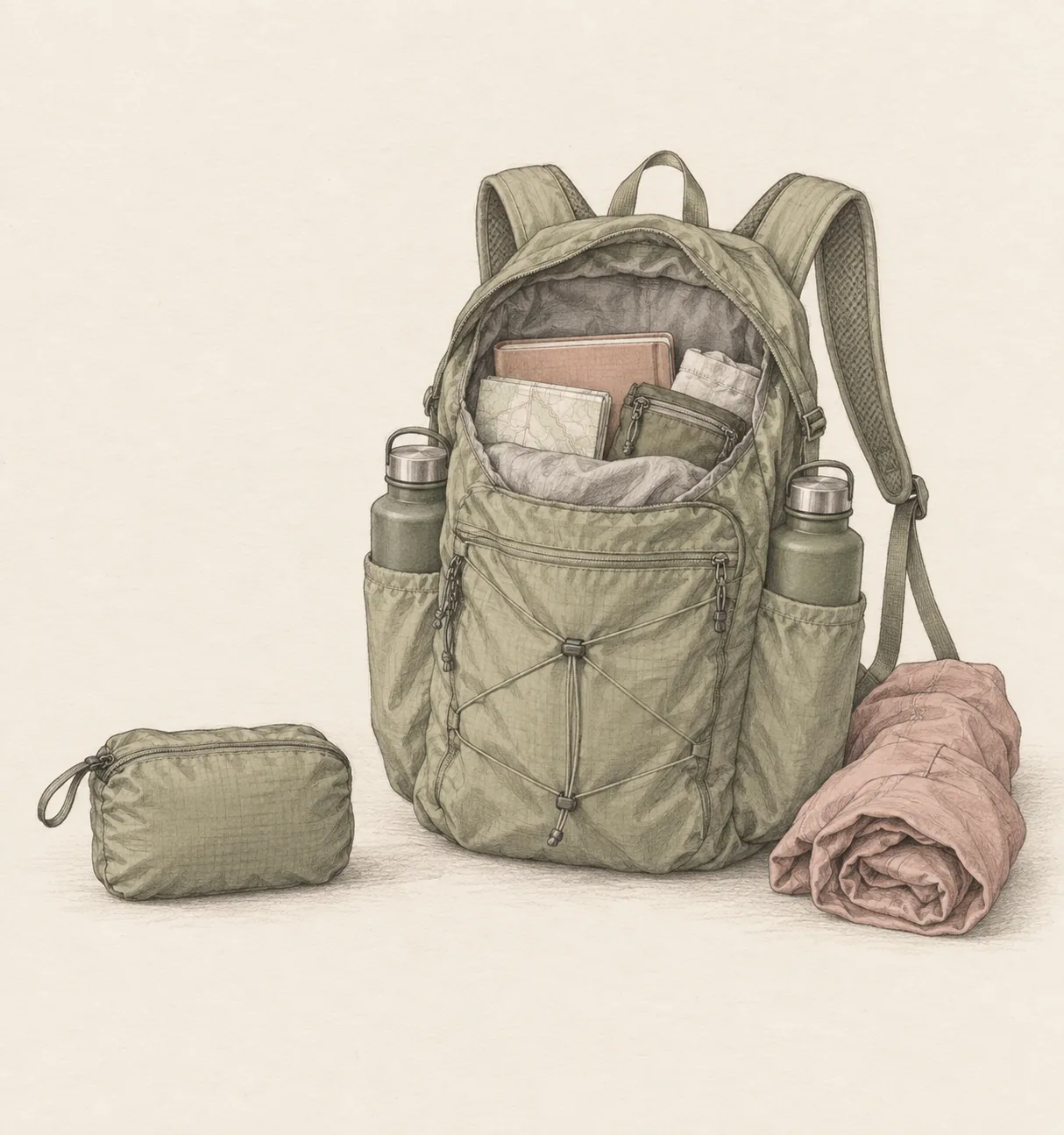
Best Packable Daypack for Travel (2026): 3 Bags That Vanish in Your Luggage
Carry-on
A packable daypack folds into a fist-sized pouch and gives you a second bag the moment you land. Start with the 4Monster 16L, the WATERFLY 20L for more room, or the Nanobag for near-zero weight.
Our picks
A packable daypack solves the problem your main bag creates. You land with one carry-on that has everything you need for the week, but you do not want to carry that bag around a city or up a trail all day. A packable daypack folds into a pouch, rides inside the carry-on, and becomes a second bag the moment you need one.
The trade is always weight against structure. The lighter the bag, the less it holds its shape and the less it carries comfortably. None of these is a hiking pack or a laptop bag. They are spare day bags, and the right one is the one you will actually keep in your luggage instead of leaving at home.
Pack one alongside the primary pack from the best travel backpack guide, and keep it in the day layer of your carry-on for a week setup. The carry-on section has the rest of the one-bag guides, including the sling bag for lighter days.
Quick comparison
Top pick: 4Monster Hiking Daypack, 16L
The 4Monster is the default because it balances weight, capacity, and durability better than the rest at this price. It weighs 4 ounces, folds into a pouch about the size of a fist, and uses tear-resistant 30D nylon with a water-resistant finish. That is enough to handle branches, sand, and a sudden shower without turning into a wet paper bag.
The layout is what makes it useful rather than just small. There is a main compartment, a front zip pocket, and two mesh side pockets that actually hold a full water bottle. Reviewers who used one daily on a beach trip fit a towel, snorkel gear, snacks, and a 24-ounce bottle, then carried it with both straps to spread the weight.
The limit is the straps. They are mesh, not padded, and the bag has no structure of its own. That is fine for a light day and wrong for a load of groceries. Treat it as a light day bag and it will last.
Skip it if you need to carry heavy loads or a laptop. Pick it as the everyday spare daypack for most trips.
Best value: WATERFLY 20L
The WATERFLY trades a little weight for more space and a better pocket layout. It opens to 16.9 by 11.4 by 5.5 inches, which is a genuine 20L day load, and folds to a paperback-sized 8.7 by 6.3 inches. The recycled nylon shell and SBS zippers feel a step up from the cheapest options.
The pocket design is the reason to pick it. There is a main compartment, two front pockets for small items, and a removable zip pocket that works as a standalone pouch. That means you can leave the bag behind and carry just the essentials, which is handy on a beach or a boat day.
It is about 10 ounces, which is heavier than the ultralight picks but still nothing in a suitcase. There is also a live deal on it right now, so if this is the size you want, it is a good time to buy.
Skip it if every gram counts. Pick it when you want a roomier day bag with better pockets.
Best ultralight: Nanobag 16L
The Nanobag is for the traveler who hates carrying a bag that is not in use. It weighs about 1.15 ounces, stuffs into its own attached pouch with no folding, and opens into a 16L daypack with wide 27-inch straps and a YKK zipper. It carries far more than it looks like it should, up to 66 pounds by the brand's rating.
That low weight comes from a very thin fabric, so it wants gentle handling around sharp edges. It also has less structure than the 4Monster, which means a light load sits better than a heavy one. For a spare bag that lives in a pocket until a rainy walk or an unplanned errand, that is a fair trade.
Skip it if you want a bag that feels substantial or carries a heavy load. Pick it when the goal is a spare bag you never notice.
What matters in a packable daypack
Weight is the first number. Anything under about 6 ounces disappears into a bag, while a 10-ounce bag is still light but noticeable. Decide whether you want the absolute lightest or a little more structure.
The pouch matters more than people think. An attached stuff sack means you will not lose the pouch, and a design that stuffs rather than folds is faster to pack away. A separate pouch tends to go missing in a suitcase.
Look at the pockets. At least one stretchy bottle pocket turns a flimsy bag into a usable one, and a front pocket keeps small items reachable. A removable zip pocket is a bonus because it doubles as a small pouch.
Finally, check the fabric and the zipper. A thicker nylon handles rough use better, and a YKK or SBS zipper is a sign the bag will not fail at the worst moment. No packable bag is waterproof, so plan on a dry bag for anything that cannot get wet.
Common mistakes
Expecting it to carry a heavy load. Packable bags have thin straps and no frame. Keep the load light and wear both straps.
Buying one that is too small to be useful. A bag that only holds a phone and a wallet is not worth the space it takes. Aim for at least 16L.
Leaving the pouch at home. A separate pouch goes missing. Choose an attached stuff sack or keep the pouch with the bag.
Packing it in checked luggage. Keep the daypack in your carry-on so it is there at a layover and cannot get lost with a checked bag.
Treating it as waterproof. Water-resistant means it shrugs off a shower, not a downpour. Use a dry bag for electronics.
Forgetting it is a second bag. A packable daypack is not a replacement for a travel backpack with a frame and a laptop sleeve.
Final takeaway
For most trips, the 4Monster 16L is the best packable daypack. It is light, folds into its own pouch, and opens into a real day bag. Choose the WATERFLY 20L when you want more room and better pockets, or the Nanobag 16L when the lightest possible spare bag is the goal.
Pack it inside the primary pack from the best travel backpack guide, then sort the rest of the bag with the carry-on section and the one bag packing list.
Frequently Asked Questions
What is the best packable daypack for travel?
The 4Monster 16L is the best packable daypack for most trips. It weighs 4 ounces, folds into its own pouch, and opens into a real day bag with two stretchy bottle pockets. Choose the WATERFLY 20L if you want more room, or the Nanobag if weight matters more than anything.
How small does a packable daypack fold?
The best ones fold to about the size of a paperback or a large fist. The 4Monster packs to roughly 2.8 by 5.1 inches and the WATERFLY to about 8.7 by 6.3 inches, so both slip into a carry-on or a personal item.
Is a packable daypack comfortable to carry?
For a light day, yes. For a heavy load, no. Packable bags use thin fabric and mesh straps instead of padding, so they are comfortable up to about ten pounds. Wear both straps to spread the weight and keep the load modest.
Can I use a packable daypack as my only bag?
You can for a day trip, but not for a multi-day trip. It has no frame, no padded laptop sleeve, and thin straps. Think of it as a second bag that stays inside your main luggage until you land, not a replacement for a travel backpack.
Can a packable daypack go as a personal item on a flight?
Often yes. Most fold small enough to fit under the seat, and the opened bag is about the size of a small daypack. Check your airline's personal item dimensions, because a full 20L bag can be slightly over a strict limit.
Are packable daypacks waterproof?
No, they are water-resistant. The nylon sheds light rain and splashes, but seams and zippers are not sealed. For a wet hike, line the bag with a dry bag or a plastic sleeve for anything that cannot get damp.
What should I look for in a packable daypack?
Look for a low weight, a pouch that is attached rather than separate, at least one stretchy bottle pocket, and a fabric that feels thicker than tissue paper. A YKK or SBS zipper is a good sign at this weight.
Is a packable daypack or a sling bag better for a day out?
A daypack carries more and spreads weight across both shoulders, which suits a full day of walking. A sling bag stays tighter to the body and is easier to swing around for a camera or a phone. Many travelers pack both for different days.